
Mapping the Maze:
Democracy, Liberalism, Socialism, and Nationalism

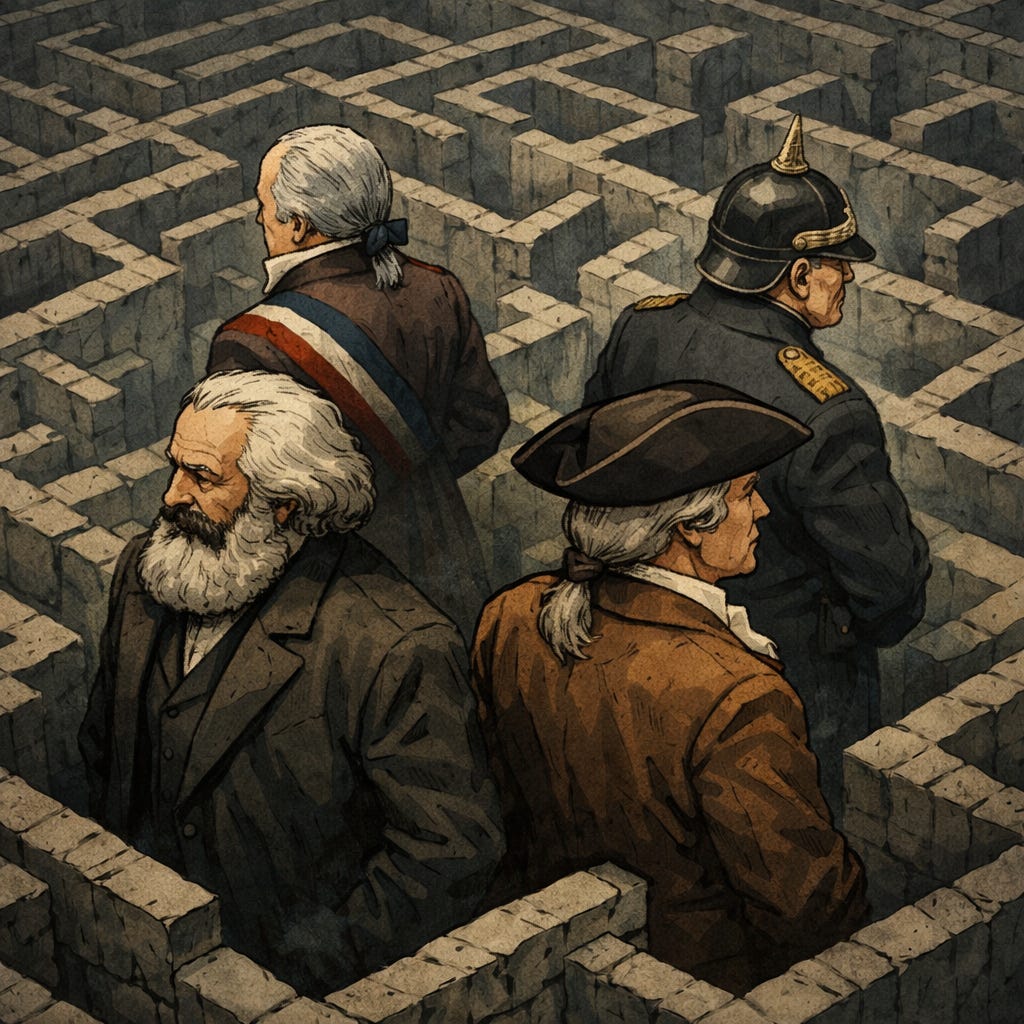
How do democracy, liberalism, socialism, and nationalism actually relate? Not easily. This is an attempt to map the maze.
Preface
The previous post argued that contemporary debates framed in terms of Left and Right often misidentify the real sources of political and economic conflict. Once governance capacity, control over economic power, and institutional performance are taken seriously, familiar ideological coordinates begin to lose their explanatory force.
That argument, however, leaves a deeper question unresolved. If the traditional dichotomy of Left and Right is no longer a reliable guide, how do the foundational ideologies of modern political economy actually relate to one another? And what changes once democracy itself is no longer treated as a unitary concept?
This post takes up that question. It does so by abandoning the assumption that democracy speaks with a single institutional voice and by extending the analytical distinction between political democracy and economic democracy into the ideological sphere. Once this distinction is introduced, the relations among liberalism, socialism, and nationalism appear in a different light. What had often been interpreted as ideological inconsistency or democratic failure emerges instead as the expression of understandable structural tensions.
The aim here is not normative adjudication. It is neither to defend nor to condemn particular regimes or traditions. Rather, it is to clarify how democracy, liberalism, socialism, and nationalism intersect, overlap, and conflict once democracy is no longer treated as a self-contained procedural ideal but as a contested form of authority extending across both political and economic domains.
Introduction: A Conceptual Puzzle That Refuses to Settle
Few terms in political economy are invoked as frequently , and with such persistent ambiguity , as democracy, liberalism, socialism, and nationalism. They are alternately treated as allies, adversaries, historical stages, or moral absolutes. Entire debates hinge on whether democracy “requires” markets, whether socialism is compatible with democracy, whether nationalism is inherently anti-liberal, or whether liberalism can survive without economic openness. These disputes recur with remarkable regularity, yet they rarely converge.
The reason is not merely ideological disagreement. It is a conceptual entanglement.
Much of the literature treats these terms as internally coherent and mutually exclusive blocs: liberal democracy versus socialism, markets versus the state, nationalism versus openness. As a result, analytical contradictions are misread as empirical failures, and historical tensions are mistaken for theoretical inconsistencies. Democracy appears to flourish and fail simultaneously; liberalism claims universality, yet its presence is shrinking worldwide. Socialism oscillates between emancipatory promises and authoritarian iron cages. Nationalism seems both regressive and indispensable.
This short paper begins from the premise that these paradoxes are not anomalies to be resolved, but structural tensions generated by the way these concepts overlap, collide, and partially contradict one another.
At the center of the confusion lies treating democracy as a unitary concept. Once democracy is analytically fused — political procedures, economic power, sovereignty, legitimacy, and social outcomes collapsed into a single category — every institutional configuration appears either incoherent or hypocritical. Liberal regimes are accused of democratic deficits; socialist projects are faulted for political illiberalism; nationalist interventions are read as democratic backsliding rather than functional overrides.
The purpose of the paper is therefore not normative adjudication. It does not seek to rank regimes or prescribe institutional blueprints. Its aim is analytical clarification: to disaggregate the key concepts at stake, map their internal tensions, and explain why certain combinations are structurally unstable while others are merely uncomfortable.
The argument proceeds by splitting democracy into political and economic dimensions; examining how political and economic liberalism relate differently to each; showing how nationalism functions as a recurrent override rather than an external aberration; and clarifying why socialism’s deepest tension lies not with democracy per se, but with the liberal political project.
What follows is a conceptual map. It does not dissolve tension and contradictions. It makes them intelligible.
The Analytical Key: Disaggregating Democracy
The first step in untangling the puzzle is to abandon the notion of democracy as a unitary object. Much of the confusion identified above arises precisely from treating democracy as a single, internally coherent principle that either “exists” or “fails” in a given regime.
Analytical clarity requires disaggregation.
Political democracy refers to popular sovereignty in the political sphere: representation, contestation, civil liberties, accountability, institutional procedures, and the mechanisms through which collective choices are articulated, revised, and reversed.
Economic democracy refers to the extension of collective authority into the economic sphere: control over investment, finance, ownership structures, surplus allocation, and the long-term direction of production, innovation, and development.
Modern political regimes routinely claim democratic legitimacy while structurally excluding economic democracy. Conversely, projects that prioritize economic democracy often encounter persistent difficulties in stabilizing political democracy in its liberal form. Once democracy is split into these two dimensions, this asymmetry ceases to be paradoxical. It becomes the central phenomenon to be explained.
The remainder of the paper examines how liberalism, nationalism, and socialism relate differently, and often antagonistically, to each dimension of democracy.
Political Liberalism: Democracy as a Dangerous Guest
Political liberalism presents itself as democracy’s natural home. Historically, it has indeed provided the constitutional and institutional framework within which modern democratic practices emerged. Yet this historical association obscures a deeper tension.
Political liberalism is not organized around popular sovereignty as such, but around the containment of power through constitutionalism, individual rights, the rule of law, and institutional fragmentation. Democracy enters this architecture not as a foundational principle, but as a conditional and carefully managed element.
From its classical foundations, political liberalism acknowledges popular sovereignty only to immediately erase it. John Locke already insisted that legislative power is merely delegated and cannot exceed its mandate. Democracy is thus accepted as a procedure, not as a substantive authority.
This logic is formalized in modern political liberalism. As John Rawls makes explicit, liberal justice is a political, not a comprehensive, doctrine. It governs the basic structure of political institutions while remaining neutral toward competing moral and economic conceptions. The implication is decisive: democratic legitimacy applies to political procedures, not to the organization of economic life.
This is why political democracy sits uneasily within political liberalism. Popular sovereignty is treated as something to be filtered, slowed, and restrained. The moment democratic claims threaten to become transformative rather than procedural, liberal safeguards come into play.
The tension becomes decisive when democracy crosses from the political into the economic domain. Economic democracy does not simply demand more participation; it politicizes domains that political liberalism treats as constitutively non-political, above all private property and control over accumulation.
Joseph Schumpeter captured this boundary with characteristic bluntness: democracy means only the ability to accept or reject rulers, not to govern outcomes[1]. Once democracy claims authority over investment, finance, or ownership, it ceases to be compatible with political liberalism by design, not by accident.
In this sense, democracy is not liberalism’s fulfillment. It is its most persistent internal tension.
Economic Liberalism and Neoliberalism: Democracy Under Structural Veto
If political liberalism seeks to contain democracy through constitutional restraint, economic liberalism hardens this logic by insulating the core mechanisms of accumulation from democratic reach altogether. Modern neoliberalism takes this even further.
Economic liberalism transforms tension into hierarchy. Where private property, market allocation, and capital mobility are treated as foundational rights insulated from political decision, democracy becomes conditional and, eventually, an existential threat.
Political democracy may persist formally, but effective authority over monetary policy, finance, investment, trade, and industrial strategy is progressively removed from democratic contestation by technocratic design and legal insulation. Markets become the ultimate veto-players.
Democratic expansion into the economy triggers predictable Polanyian counter-movements: capital flight, disinvestment, jurisdictional arbitrage, and the depoliticization of economic policy through rules, independence mandates, and supranational constraints.
Democracy is not abolished, but it is structurally subordinated.
Nationalism: Sovereignty, Democracy, and Liberalism as a Special Case
Nationalism is often portrayed as liberalism’s political antagonist — a regressive force opposed to openness, pluralism, and market coordination. This framing is misleading. It implicitly treats liberalism as the historical norm and nationalism as a deviation. The opposite is closer to the truth.
Nationalism is older, more general, and more deeply rooted than liberalism. The organization of political life around bounded communities, collective identity, sovereignty, and survival long predates liberal constitutionalism and market universalism. Liberalism emerges historically as an exceptional attempt to neutralize politics — to subordinate questions of power, hierarchy, and security to rules, rights, and market coordination.
Liberalism presupposes a geopolitical environment of stability, secure borders, and depoliticized economic exchange. Under such conditions, markets can appear autonomous, and political authority can present itself as neutral. When these conditions erode — through war, technological rivalry, sanctions, or systemic crisis — the primacy of political sovereignty re-emerges.
Nationalism, in this sense, does not “return” when liberalism fails. It reasserts itself when the exceptional conditions that temporarily suppress it disappear. Politics cannot be fully reduced to norms, procedures, or market coordination. It ultimately rests on the possibility of existential conflict — situations in which the survival or autonomy of a political community is perceived to be at stake. In such moments, decisions cannot be deferred to impersonal rules.
Liberalism seeks to neutralize politics through rights and constitutional constraint. This does not remove conflict, but disguises it by translating political decisions into legal form.
The relationship between nationalism and democracy follows a different, though related, logic. There is no inherent incompatibility between the two. Democracy, in Liberalism seeks to neutralize politics through rights and constitutional constraint. This does not remove conflict, but disguises it by translating political decisions into legal form. As Carl Schmitt argued, sovereignty reappears in the power to decide on the exception. its political and economic dimensions, presupposes a bounded political community capable of collective decision, enforcement, and sacrifice. Popular sovereignty is unintelligible without a demos, and the demos has historically been constituted in national terms. As Otto Bauer emphasized, democracy is not opposed to national belonging; it is mediated through it.
The tension arises not at the level of principle, but at the level of priority, and becomes visible in critical conjunctures.
Under conditions of relative stability, nationalism and political democracy can coexist with limited friction. Democratic procedures operate within national boundaries, while nationalism remains largely latent. War, pandemics, systemic financial crises, technological rivalry, sanctions, or direct challenges to state authority disrupt this equilibrium. In such moments, collective survival, sovereignty, and strategic autonomy take precedence over procedural openness.
When this occurs, nationalism consistently trumps democracy — but not symmetrically across its two dimensions.
Political democracy is affected first and most visibly. Contestation, procedural delay, rights-based constraints, and pluralist dissent are compressed or suspended on the grounds that democratic openness cannot be allowed to obstruct collective survival. Emergency powers and executive discretion follow not from a rejection of democracy, but from its conditional subordination.
Economic democracy is also subordinated, but through a different mechanism. Crises reorganize economic authority around imperatives of mobilization and security. Investment, finance, production, and distribution are redirected through centralized coordination rather than participatory control. Democratic claims over accumulation are not denied in principle, but postponed or mediated through the state. Expanded state intervention under nationalism should therefore not be confused with the suppression of economic democracy.
Nationalism thus operates as a hierarchical override across liberalism and democracy alike. It exposes liberalism’s utopian premise — that markets and rights can remain sovereign regardless of power and conflict — and reveals democracy’s contingency on political authority. Democracy governs within national boundaries, and only so long as those boundaries themselves are not under threat.
Socialism: Economic Democracy and Substantive Legitimacy
Socialism sits comfortably with economic democracy. Collective authority over accumulation, investment, and surplus allocation is not a concession to democratic pressure, but its organizing principle. From its classical formulations onward, socialism has treated the economy not as a neutral coordination mechanism but as the central terrain on which power is exercised, and wealth is created and extracted.
Karl Marx framed this point with uncharacteristic clarity. Political equality confined to the formal sphere leaves untouched the social relations that structure power and life chances. What ultimately matters is not only who governs, but who governs accumulation, wealth distribution, and the conditions of social reproduction. Economic democracy, in this sense, is not an ideological supplement to genuine democracy, but its material foundation.
The deepest tension of socialism, therefore, lies not with democracy as such, but with political liberalism and the liberal form of political democracy. Liberal pluralism demands neutrality toward outcomes, rapid alternation of power, and multiple filtering layers that preclude the identification and fulfillment of the public interest. Socialism, by contrast, is goal-oriented. It is oriented toward the materialization of a collective project rather than abstract liberties, and therefore requires purposive coordination, long-term horizons, and institutional continuity to organize production, investment, and distribution.
Lenin gave this tension a stark political formulation. Projects of structural transformation cannot dispense with political forms – the disciplined Party - designed to arbitrate among fixed interests within an unchanged economic order. This is not, per se, a rejection of democracy, but a recognition that transformative economic projects impose demands on political organization that liberal procedures are not designed to meet.
From this perspective, socialism is neither inherently authoritarian nor inexorably democratic. Its political problem is not legitimacy in the abstract, nor the prior fulfillment of liberal-democratic forms. Rather, it is the capacity to achieve legitimacy through outcomes: by delivering economic security, social rights, and a trajectory toward broadly shared material abundance.
In this sense, democracy appears less as a precondition than as an achievement. Political consent, participation, and accountability are stabilized not primarily through ex ante procedures, but through the sustained fulfillment of collective promises. Where insecurity, scarcity, and volatility dominate, democratic forms remain fragile; where economic stability and shared prosperity prevail, democratic legitimacy acquires a durable material foundation.
This insight was developed with particular sophistication by ethical socialist traditions. Mikhail Tugan-Baranovsky argued that socialism is ultimately justified not by coercion or uniformity, but by its capacity to align economic organization with ethical and developmental objectives. Collective control over economic affairs was, for him, the mechanism through which society could overcome cyclical instability, direct surplus toward socially chosen ends, and reconcile economic efficiency with moral purpose.
Socialism is also compatible with nationalism understood as developmental sovereignty. Economic democracy requires a bounded political community capable of enforcing collective choices against external market discipline. Without such boundaries, democratic control over accumulation is systematically undermined by capital mobility, geopolitical hierarchy, and external constraint.
Seen in this light, socialism does not negate democracy. It redefines the path through which democratic legitimacy is built: not by insulating the economy from politics, but by subordinating economic organization to collectively chosen ends and evaluating political authority by its capacity to deliver shared abundance over time.
The Full Configuration Mapped Out
Once the preceding elements are brought together, the problem's underlying structure comes into view.
Political democracy occupies an inherently ambiguous position within political liberalism. Liberal institutions provide democracy with its procedural form yet simultaneously restrict its scope. Popular sovereignty is recognized only insofar as it remains filtered through constitutional restraint and insulated from substantive control over outcomes. Democracy is thus accommodated as a method, not as governance scaffolding.
The tension intensifies when democratic claims extend into the economic sphere. Economic democracy does not merely deepen participation; it directly challenges the liberal settlement by politicizing accumulation, investment, and ownership. At this point, political liberalism reaches its limit. What had been an uneasy coexistence becomes a foundational conflict.
Economic liberalism resolves this conflict not by mediation, but by hierarchy. By constitutionalizing markets and insulating core economic mechanisms from democratic intervention, it subjects political democracy to a permanent structural veto. Democratic choice remains formally intact, yet substantively constrained by the threat of disinvestment, capital flight, and market discipline. The recurring cycle of “elect and regret” is its predictable outcome.
Nationalism enters this configuration not as an external anomaly, but as a norm, and a functional override. Liberalism presupposes conditions of relative security under which markets can appear autonomous and political authority neutral. When these conditions erode — through war, systemic crisis, or geopolitical rivalry — the primacy of political sovereignty reasserts itself. In such moments, liberal constraints are suspended, markets subordinated, and economic coordination re-politicized. This override does not abolish democracy as such but reorders it hierarchically: political democracy is curtailed most immediately, while economic democracy is reshaped or postponed. Nationalism thus exposes what liberalism seeks to deny — that market primacy and procedural neutrality are always conditional on political authority.
Socialism aligns structurally with economic democracy, embracing collective authority over accumulation as its organizing principle. Its friction lies elsewhere — with the liberal political form. Transformational economic projects require purposive coordination, long time horizons, and institutional continuity, all of which strain liberal commitments to neutrality and rapid alternation. This tension reflects not democratic failure, but a mismatch between liberal political procedures and democratic-oriented economic transformation.
Taken together, these relationships form a coherent, complex, and unstable configuration. Democracy is not simply opposed to markets or states. It is internally divided. Liberalism is not democracy’s natural match, but a conditional arrangement that stabilizes political equality by excluding economic sovereignty. Nationalism and socialism, in different ways, expose and contest this exclusion.
What appears in contemporary debate as contradiction or hypocrisy is better understood as the expression of these unresolved structural tensions.
Conclusion: Democracy and The Utopian Bias of Liberalism
The deepest contradiction explored in this paper is not democracy versus the state, nor democracy versus markets or national borders taken in isolation. It is an attempt to reconcile political equality with entrenched economic hierarchy while insulating the organization of accumulation and the boundaries within which it operates from collective control.
Liberal democracy manages this contradiction by narrowing the domain of democracy itself. Political rights are stabilized by excluding economic democracy; popular sovereignty is affirmed procedurally while denied substantively. Liberalism survives not by resolving the tension between democracy and hierarchy, but by displacing it — proceduralizing democracy while insulating markets and treating political boundaries as neutral backdrops rather than sites of power.
This displacement is historically contingent rather than universal. Economic democracy, nationalism, and socialism, in different ways, expose the fragility of the liberal settlement. Economic democracy politicizes accumulation and investment, forcing into view questions liberalism seeks to neutralize. Nationalism reasserts sovereignty when security, survival, or geopolitical rivalry make neutrality impossible. Socialism confronts the contradiction directly by subordinating accumulation to collectively chosen ends, but in doing so brings into tension the liberal political form itself. None of these phenomena is anomalous. All reveal the limits of liberalism’s claim to universality.
The utopian bias of liberalism lies precisely here: in the belief that markets can remain autonomous, politics neutral, and democracy procedural regardless of hierarchy, power, conflict, and boundary. That belief can be sustained only under exceptional historical conditions. When those conditions erode, the suppressed questions return — not as theoretical puzzles, but as political struggles.
Seen from a truly democratic perspective, contemporary debates over democracy, socialism, and nationalism are not signs of conceptual confusion or ideological extremism. They are expressions of unresolved structural tensions that liberalism cannot finally settle. From that perspective, the extremely difficult question is not whether economic democracy should govern accumulation, but how — and in whose name. Posed in these terms, the question shifts attention decisively to the prospects of economic democracy, and exposes the structural limits of political democracy when treated as a self-sufficient foundation of democratic life.
References
Bauer, O. (1907 [2000]) The Question of Nationalities and Social Democracy. University of Minnesota Press.
Keynes, John Maynard. 1936. The General Theory of Employment, Interest and Money. London: Macmillan.
Lenin, V.I. (1917 [1964]) The State and Revolution. In: Collected Works, Vol. 25. Moscow: Progress Publishers.
Locke, John. 1689 [1988]. Two Treatises of Government. Cambridge: Cambridge University Press.
Marx, Karl. 1875 [1970]. Critique of the Gotha Programme. Moscow: Progress Publishers.
Polanyi, Karl. 1944. The Great Transformation. New York: Farrar & Rinehart.
Rawls, John. 1993. Political Liberalism. New York: Columbia University Press.
Schmitt, C. (1932 [2007]) The Concept of the Political. Expanded ed. Translated by G. Schwab. Chicago: University of Chicago Press.
Schumpeter, Joseph A. 1942. Capitalism, Socialism and Democracy. New York: Harper & Brothers.
Tugan-Baranovsky, M. (1918 [1966]) Modern Socialism. Translated by A.M. Thomson. Forgotten Books
[1] This formulation reflects the liberal conception of democracy, stripped of all its glamour.
Good one Leo. Nicely done.
The only thing I would add is an analysis of a social contract. Socialism doesn’t need nationalism (except for jurisdictional boundaries), it can rule by contract and socialist governance. However, a socialist contract would be radically different from a liberal contract. Both Liberalism and Nationalism require a ruling class.
If the economy is insulated from democracy how do you explain the vast regulation and expansion of the welfare state and redistribution programs?
Liked very much- well explained, clear.